


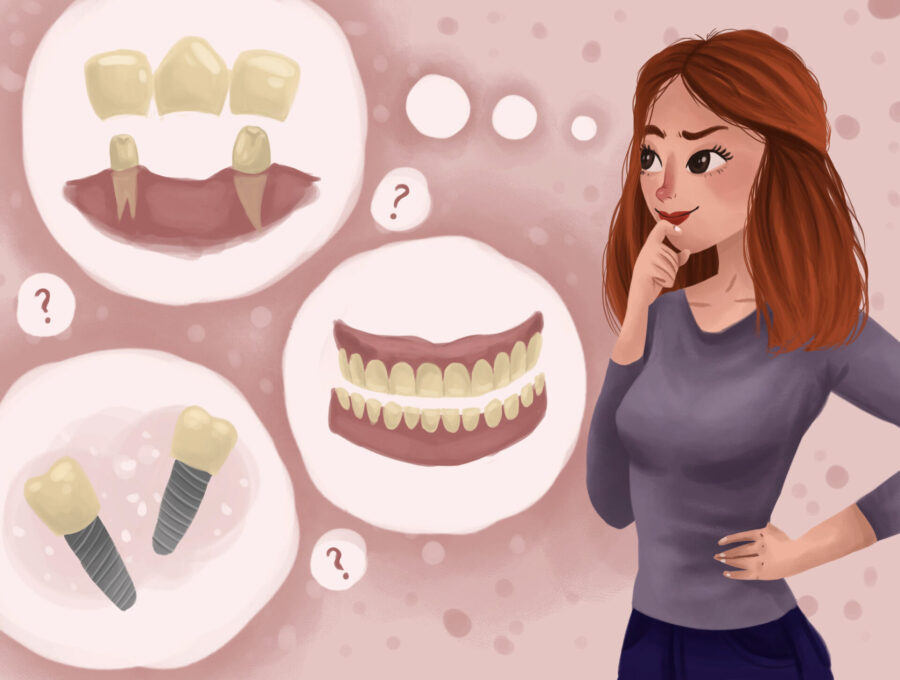
Losing a tooth can change more than the way your smile looks. You may start chewing more on one side, notice food catching in the space, or feel the neighboring teeth beginning to shift. Once the area has healed, the next question is usually what you want to put back in that space.
At Jones Creek Family Dentistry in Baton Rouge, Dr. Courtney Perkins Jones offers several ways to replace missing teeth, including dental implants, bridges, dentures, and implant-supported dentures. The best fit depends on how many teeth are missing, the health of the teeth around the space, how much bone is available, and whether you want something fixed or removable. We look at those details together and talk through what each option would mean for you.
If you are missing one tooth, you may have more than one good option. An implant may make sense if you want to replace the tooth without involving the neighboring teeth, while a bridge may be a good choice if you want a fixed restoration and the teeth beside the space can support it. Meanwhile, a removable partial can replace one or several teeth when you want a different approach.
Options to Replace a Missing Tooth
For one missing tooth, the three main options are usually a dental implant, a dental bridge, or a removable partial denture. They all fill the space, but they do it in different ways. The right choice depends on how you want the replacement to function and what the rest of your mouth looks like.
A dental implant replaces the missing root with a titanium post placed in the jawbone, then a crown is attached on top. A bridge uses the teeth on either side of the gap to support a replacement tooth between them. A partial denture, on the other hand, is removable and fits around the natural teeth you still have.
If several teeth are missing, there are more possibilities. Depending on the location and number of spaces, we may talk about a partial denture, multiple implants, an implant-supported bridge, a full denture, or an implant-supported denture. So, the plan can look very different from one person to the next.
Dental Implants Replace the Tooth From the Root Up
A dental implant is one of the closest ways we have to rebuilding a missing tooth from the foundation up. The implant itself is a small titanium post that is placed in the jaw where the tooth root used to be. After it heals into the bone, we can place a crown on top to replace the visible tooth.
Because the implant stands on its own, we do not have to use the neighboring teeth to hold the replacement in place. You can brush and floss around it much like a natural tooth, and there is no removable appliance to take in and out at night. For many people, that day-to-day feel is a big part of the appeal.
The implant also gives the bone something to hold onto. Natural tooth roots stimulate the jawbone when you chew, and that stimulation is lost when a tooth is removed. An implant transfers pressure back into the bone, which can help preserve bone in that area over time.
What the Dental Implant Process Looks Like
Implant treatment takes more time than a bridge or partial denture because the bone needs time to heal around the implant before the final crown is placed. We start by looking at the space, the surrounding teeth, and the amount of bone available. Imaging helps us see whether the site is ready for an implant or whether a graft may be needed first.
If there is enough healthy bone, the implant can be placed into the jaw. Then we allow time for the bone to integrate around it, which creates the stable foundation we need for the replacement tooth. Once that healing period is complete, an abutment and crown are placed on top.
In some cases, there is not enough bone to support an implant right away. That can happen if the tooth has been missing for a long time, if there was bone loss from gum disease, or if the area lost bone after an infection. A bone graft may be recommended first to build up the site before implant placement.
A Dental Bridge Gives You a Fixed Replacement
A dental bridge fills the space by using the teeth on either side for support. Those supporting teeth are prepared for crowns, and the replacement tooth is attached between them. Once the bridge is cemented in place, it stays in your mouth.
For someone who wants a fixed option without implant surgery, a bridge may be a good fit. It can restore chewing in the area, close the visible gap, and help keep neighboring teeth from drifting into the open space. It also avoids the healing period that comes with an implant.
The condition of the supporting teeth plays a big role in whether we recommend a bridge. If one or both teeth already need crowns because they have large fillings or other damage, using them to support a bridge may fit well into the treatment plan. However, if both neighboring teeth are healthy and untouched, an implant may be worth considering because it leaves those teeth alone.
What It Is Like to Live With a Dental Bridge
A bridge stays in place, so there is nothing to remove after meals or at night. You can eat and speak with it in place, and most people settle into the feel of it pretty quickly. For day-to-day use, it behaves much more like a fixed tooth replacement than a removable appliance.
Cleaning does take a small adjustment because the replacement tooth is connected to the crowns beside it. You cannot pass floss straight down between those connected teeth the way you can around individual teeth. Instead, you clean underneath the bridge with floss threaders, interdental brushes, or another tool we can show you how to use.
Keeping that area clean is important because the supporting teeth are still natural teeth underneath the crowns. Decay or gum problems around those teeth can affect the bridge, so daily cleaning around the margins and underneath the replacement tooth needs to become part of your routine. Regular visits also give us a chance to keep an eye on those supporting teeth.
A Removable Partial Denture Can Replace One or Several Teeth
A partial denture can replace one missing tooth, several missing teeth, or multiple spaces in the same arch. It fits around the natural teeth you still have and uses them for support. That makes it a good option when the missing teeth are spread across more than one area.
Unlike an implant or bridge, a partial is removable. You will take it out to clean it and usually remove it at night, then place it back in during the day. Some people adjust to that routine easily, while others know they would prefer something fixed.
One advantage of a partial is that it can replace several teeth at once without placing an implant in every space. That can make it a more affordable option when multiple teeth are missing or when implant treatment is not a good fit medically, financially, or anatomically. It also gives us more flexibility when the spaces are spread out.
When a Partial Denture Makes More Sense
A partial can be a good choice when several teeth are missing in different areas of the mouth. Instead of treating each space separately, one appliance can replace multiple teeth at the same time. That can make the overall plan easier to manage.
It may also make sense if the bone is not ideal for implants and you do not want to go through grafting. Likewise, if the neighboring teeth are not good candidates to support a bridge, a partial gives us another way to restore the space. In some cases, one appliance can replace several areas at once.
Cost can be part of the decision too. Implants generally require a larger upfront investment, particularly when several teeth are involved. A partial can give you a more affordable way to restore chewing and fill the spaces without committing to multiple surgical procedures.
What if You Are Missing Several Teeth in a Row?
When several teeth are missing next to each other, you may have several ways to rebuild that area. A removable partial can replace the whole section, or implants may be used to support multiple replacement teeth. Which direction makes more sense depends on the span, the bone, and how fixed you want the result to be.
You do not necessarily need one implant for every missing tooth. In some cases, two implants can support a bridge that replaces several teeth between them. That can reduce the number of implants needed while still giving you a fixed result.
The amount and quality of bone become more important as the treatment gets larger. We also look at where the missing teeth are, how much chewing force that area receives, and what the opposing teeth look like. Those details help us decide how many implants are needed and where they should go.
If Most or All Teeth Are Missing, Dentures May Come Into the Picture
A full denture replaces all the teeth in the upper or lower arch. If many teeth are already missing or the remaining teeth cannot be predictably restored, a denture can rebuild an entire arch at once. It gives us a way to restore appearance and basic chewing function across the whole mouth.
Traditional dentures rest on the gums and are removable. They can restore appearance and basic chewing function, but they do not have the same stability as teeth supported by implants. The lower denture, in particular, can move more because there is less surface area available to hold it in place.
For someone missing all or nearly all of their teeth, dentures can still be a good option. They are generally more affordable than replacing every tooth with implant-supported restorations, and they can restore a smile much faster. From there, we can also talk about whether implants would improve the fit and function of the denture.
Implant-Supported Dentures Add More Stability
Implant-supported dentures combine a denture with dental implants placed in the jaw. Instead of relying only on the gums for support, the denture connects to implants, which can reduce movement while you eat and speak. That added stability can make a noticeable difference day to day.
This can be a big improvement for someone who has struggled with a loose lower denture. The implants give the denture something stable to attach to, so it does not shift as freely during chewing. Depending on the design, the denture may still be removable for cleaning, or the restoration may be fixed in place and removed only by the dental team.
Implants also provide stimulation to the jawbone, which can help preserve bone compared with a traditional denture alone. So, if you are missing many teeth and want more stability than a conventional denture provides, this may be worth discussing.
Why Replacing a Missing Tooth Can Help Your Bite
A missing tooth leaves more than an empty space. Over time, the neighboring teeth can begin leaning into that space, while the tooth above or below it may move farther out of its normal position. Those changes can slowly alter the way your bite fits together.
Once teeth start shifting, certain areas may take more pressure than they used to, and cleaning between the teeth can become harder. Food can also catch more easily around tilted teeth. As a result, one missing tooth can eventually start affecting the teeth around it.
Replacing the missing tooth helps fill the space and gives the surrounding teeth a reason to stay where they are. That can help keep your bite more stable and make chewing on that side feel more natural again. It can also make the area easier to clean.
How Bone Loss Affects Your Options
After a tooth is removed, the jawbone in that area begins to change because the root is no longer there to stimulate it. The amount of bone loss varies, but the longer a tooth has been missing, the more likely we are to see some change in the ridge. That can influence what we have to work with later.
This becomes most relevant when you are considering a dental implant. We need enough bone around the implant to hold it securely, so imaging helps us see the height, width, and shape of the bone before we plan treatment. From there, we can see whether the site is ready.
If the bone has thinned, grafting may allow us to rebuild the area. Depending on the site, the graft may be done before implant placement or at the same time. Meanwhile, a bridge or partial denture may still be available even when the ridge has changed quite a bit.
Implant, Bridge, or Partial: How Do You Choose?
If you are missing one tooth, start with how you want the replacement to function day to day. An implant and a bridge stay in place, while a partial denture comes in and out. That difference alone can help narrow things down pretty quickly.
Then we look at the teeth around the space. If the neighboring teeth are healthy and untouched, an implant lets us leave them alone. If those teeth already need crowns, a bridge may fit naturally into the treatment plan.
Bone and healing time come next. An implant needs enough bone and several months of healing, while a bridge can usually be completed much sooner. A partial may also be finished more quickly and may cost less upfront.
From there, we look at your oral health, budget, timeline, and how you want the replacement to feel every day. Those pieces usually make the options easier to compare. We can walk through the differences with you and answer questions as they come up.
How Cost Fits Into the Decision
The cost depends on how many teeth you are replacing and whether anything else needs to be done first. An implant may cost more if grafting is needed before placement, while a bridge includes the crowns on the supporting teeth. A partial denture may cover several spaces at once for a lower upfront cost.
Meanwhile, implant-supported options usually cost more upfront because they involve surgery, components, and additional appointments. The tradeoff is that they can offer more stability and avoid a removable appliance. For some people, that difference is worth the additional investment.
Insurance coverage can also vary quite a bit between these treatments. Some plans contribute toward bridges or dentures but offer limited implant coverage, while others may include part of the implant restoration. Our team can help you review the estimate so you know what your plan is expected to cover.
How Long Does Tooth Replacement Take?
A bridge can often be completed over a shorter period because there is no implant healing phase. The supporting teeth are prepared, impressions or scans are taken, and a temporary bridge may be placed while the final restoration is being made. Once the final bridge is ready, it is cemented into place.
Implants take longer because the bone needs time to heal around the titanium post. If grafting is needed first, that can add more healing time before the implant is placed. After the implant has integrated with the bone, the crown can be added.
A removable partial or denture also requires several steps to get the fit and bite right, but there is usually no surgical healing phase unless extractions are part of the plan. So, if timing is important to you, we can factor that into the discussion from the beginning.
What Happens at a Tooth Replacement Consultation?
We start by looking at the space and the teeth around it. Dr. Jones may also review X-rays or other imaging to check the bone, roots, and surrounding structures. That gives us a better sense of which options fit the area.
Then we can narrow things down. If an implant is possible, we look at the bone and gum health. If a bridge is being considered, we look closely at the neighboring teeth, and if a partial is on the table, we look at the rest of the arch and where it would get support.
From there, we talk about timing, cost, maintenance, and what each option would feel like day to day. Some people already know they want something fixed, while others are open to a removable option if it keeps treatment simpler. Either way, you leave with a clearer idea of what each choice would involve.
Replacing a Missing Tooth at Jones Creek Family Dentistry in Baton Rouge, LA
At Jones Creek Family Dentistry in Baton Rouge, Dr. Courtney Perkins Jones offers several ways to replace missing teeth, including dental implants, bridges, dentures, and implant-supported dentures. We can look at the space, the health of the surrounding teeth, and the available bone, then talk through which options fit you best. From there, we can build a plan around how you want the replacement to feel and function.
If you are missing one tooth, several teeth, or have been living with a gap for a while, schedule a consultation and come see us. We can compare the options, answer your questions, and help you find a replacement that feels comfortable for you day to day. We’d be happy to help you get your smile feeling more complete again!
Contact UsImage from Authority Dental under CC 2.0